
- Josef Krebs
- Donor Relationships
Reading Time: 7 minutes
The Year-End Campaign Plan That Works
Content Note: Brief, non-graphic mention of domestic violence loss.
A strong winter campaign comes together in phases. Here they are.
Phase 1: Data and Stories
Before anything else, you need to be able to answer the core question of the fundraising equation:
How much, by when, for what, from whom?
That’s the asking equation — the rest of development work is how to meet with and cultivate new people into supporters. If you can’t answer that question for your donor list, stop and answer it before you do anything else.
Alongside the data, gather your stories. You’ll be sharing stories of your work throughout the campaign, so collect them now. The data tells you who to ask; the stories give you what to say.
Phase 2: Set a Goal You Can Smash
This is not the time for magical thinking. When approaching a fundraising goal, go in with your eyes wide open: goals are meant to be beaten, not white knuckled. You want to beat it because people like to be part of winning teams. A few principles:
- Cut the goal down to a manageable size if you can.
- An achievable goal you exceed is worth more than an ambitious goal you miss.
- If you’ve set an unreasonable fundraising goal, the rest of this plan won’t work — revisit it now.
And understand your gift pyramid. Say the goal is $100,000. You want roughly $50,000–$70,000 stacked up from major donors, so you’re closing the last $30,000 or so through the broad-based campaign. For a $100,000 target, that means:
- A couple of donors who can come in at $20,000 or $10,000
- Several at $5,000
- Several at $2,500
- Then the base of the pyramid: the $1,000s, the $500s, and the many smaller gifts
Understand your pyramid and understand what the data supports — that’s the data work and the goal-setting work coming together. Don’t underestimate that base. It’s often where most of your donor count lives, and it’s a big part of what makes a campaign feel inclusive; everyone who wants to be part of the win gets a way in, at a level that works for them.
Many organizations are raising smaller amounts, and the same shape scales down. A $50,000 goal looks like this — roughly $25,000–$35,000 stacked from major donors, closing the last $15,000 or so through the broad-based campaign:
- A couple of donors who can come in at $10,000 or $5,000
- Several at $2,500
- Several at $1,000
- Then the base of the pyramid: the $500s, the $250s, and the many smaller gifts
And a $25,000 goal — roughly $12,500–$17,500 from major donors, closing the last $7,500–$10,000 broadly:
- One or two donors who can come in at $5,000 or $2,500
- Several at $1,000
- Several at $500
- Then the base of the pyramid: the $250s, the $100s, and the many smaller gifts
Don’t have donors who can give $10,000 or more? No worries! “Major gift” is relative to your organization, not a fixed number. If your typical gift is $50, then $500 might be a major gift for you. Look at your own donor history and figure out what the top tier realistically looks like for your org.
Whatever the number, the proportions hold: the majority stacked up top before the public campaign begins, and the broad base bringing it home.
Phase 3: Develop the Core Ask
The core ask is like a case statement: it covers what you’re going to talk about during the campaign. It has a form:
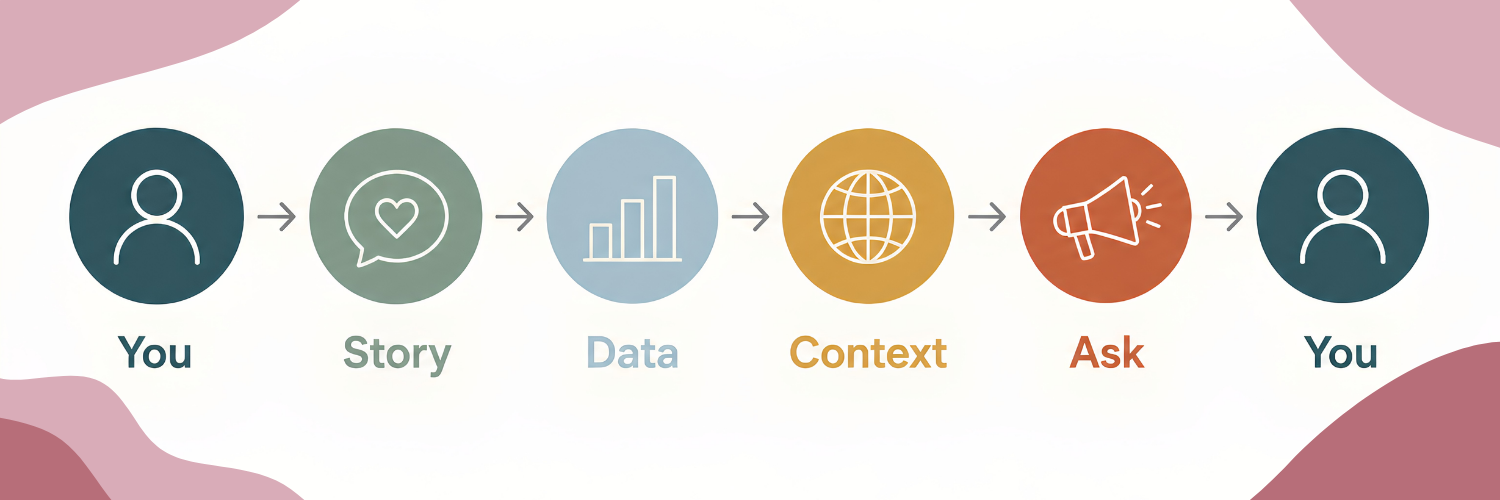
Here’s the shape in detail.
- You. A statement of who you’re speaking to and why. You’re receiving this letter because you’ve shared an interest in our work — and in many cases, you want to support it.
- Story. Tell a story about the impact of your work. Ground it in your participants’ and attendees’ stories:
- If you’re an arts organization, talk about the work you’ve done with artists — which artists you’ve engaged, and how you’ve worked together to improve the world for art and to make really great art.Don’t lose sight of the bigger picture, either: art reaches people in ways other things can’t, sparks innovation, and — especially for kids — improves how people learn. It builds empathy and gives communities a shared experience to stand around. That’s worth naming explicitly, not just implying.
- If you’re an activist organization, talk about the change you’ve made and the community you’ve brought together.
- If you’re a social service organization, ask the people you serve — delicately — whether they’re willing to share their stories. Considerable work has gone into the question of who gets to tell whose stories, and it deserves your attention. Some organizations have adopted strong ethics around this, including the team at ROOTS Young Adult Shelter.
- With every story, determine who gets to tell whose story, what the perspective is, and who is in control of the narrative. Do not engage in trauma porn or poverty porn.
- Never use guilt. I once attended a gala where the organization told the story of a person who died of domestic violence — because, they said, we hadn’t been there to give the organization money. That’s terrible. People don’t give because they feel like you need it. People give because they want you to succeed — because they like providing opportunities and resources for communities to advance their collective needs and for individuals to achieve.
- Don’t stop at one story. Tell one person’s story in multiple parts, or keep several stories ready to go — you’ll need content for weekly emails through November and December. If you do decide to tell a single story that unfolds over the course of the campaign, map it out in advance, and handle it with care.
- Data. Numbers. What are you counting, and how? How do you measure success and the efficacy of your programs? If you’re measuring program efficacy, this section writes itself. If you’re not, it’s harder. Some starting points:
- Arts organizations: attendance alone won’t carry it. Talk about new works, the works that got people excited, the most important work you did this year, and your community partnerships. Talk about the number of artists you employed/paid or gave work to. Talk about how your audience grew or changed, and how your relationship with your audience deepened — and you should have numbers on all of that. Supporters like to know the organization is strong.
- Activist organizations: Talk about the number of volunteers organized. How many petitions signed, campaigns completed, subscribers added?
- Whatever you count, be able to talk about what you counted, who you counted, and what the impact was.
Story and data work as a pair: the story tells the emotional angle of what the money is doing, and the data shows the numerical results. This taps into how our brains actually process information. First the quick, emotional gut reactions, then the slower, more deliberate reasoning. Story hooks the heart, data seals the deal.
- Context. We are raising X by Y for Z (how much, by when, for what, from whom). We’re raising $100,000 by the end of the year to generate the cash we need to continue moving forward. We’re raising $50,000 by December 31 to make sure all of our students have high-quality art supplies. Always tell people the amount, the deadline, and the purpose — and know from whom it’s coming, which is what your data and your pyramid answer.
- Ask. Specific amounts for specific people. Josef, could you consider making a gift of $500 toward our goal? Or: Josef, last year you made a gift of $500 — thank you. This year, could you consider a gift of $750, or perhaps $50 a month, bringing you to $600? This is why you need your data — and why you organized it back in Phases One and Two: data, stories, and goal setting.
- You. The best way to say you again at the end of the letter is to say “Thank you for considering our request. If you have any questions, I’m happy to answer them.”
Phase 4: Major Gifts (September 15 – November 1)
- By September 15, be organized to talk with your major donors, so your major donor conversations are ready to go by the beginning of October.
- By November 1, have all of your major gifts solicited. That should represent the vast majority of the money. And getting it done early is what makes everything that follows possible.
Phase 5: Turn Your Major Gifts Into Momentum
Here’s the move that ties it together. If you’ve closed your top 10% of donors by November 1, you can go out to the remaining 90% with a motivating match up above.
- Bring the major gifts together and present them as a match.
- Aim to have about 50% of your goal in hand, so you can say: we’ve already raised X of Y.
- Momentum is established before the public campaign begins — you’re showing people a campaign that’s winning.
- When December arrives, you’re not scrambling to close every last gift. Most of them are already done.
Phase 6: The Broad-Based Campaign (November – December)
November and December are for your broad-based campaign — your donor acquisition campaign. This is where you invite everyone who has been involved in your work over the last several years to give.
- Use multiple channels in multiple waves: letters, postcards, and email.
- Social media doesn’t raise much money. Personal outreach does.
- As the campaign intensifies, plan on one to two emails per week.
- Include a goal update in every email, and share a story of your work with every update. The update tells people where the campaign stands; the story reminds them why it matters.
- Have six or seven emails ready to go before the campaign begins.
- Consider whether it makes sense to pause fundraising during major holidays/meaningful cultural observances. For some organizations, that may include Thanksgiving, Christmas, Hanukkah, Diwali, Solstice, and other holidays.
Phase 7: The Last Two Weeks of December
By the final stretch, you’re essentially in acquisition mode, inviting people to join your work this end of year. Many people make their giving decisions at the very end of December, once their other holiday obligations are behind them.
- Have automated messages scheduled for the last week of the year.
- Between Christmas and New Year’s, plan on roughly three emails. It may seem like a lot, but the people who unsubscribe were unlikely to give anyway — unsubscribes actually save you money. You want the people who are going to give.
- Remind people that you’re an option they can give to, without being pushy.
- Post updates on your goal — a dynamic thermometer works well — so that when you reach it, you can announce it, launch a stretch goal, or simply thank everyone for making your work possible.
Phase 8: Announce Your Results (Early January)
Especially if you’ve been successful, tell your community—and be sure to thank them. Don’t forget to build in a regular thanking practice throughout your end-of-year campaign. Finally, wish them a bright new year, and let them know they’ve made your new year bright, too.
Continue the Conversation
A great year-end campaign doesn’t start in December, it starts with a plan. Join SK co-founder Josef Krebs on Friday August 28 10-11am PT for a free Zoom workshop on building a successful year-end campaign that fits your organization and your goals. We’ll walk through an eight-phase framework that covers how to set a realistic fundraising target, craft the core message of your campaign, choose the stories and data that matter most, and build momentum before year-end. Then, we’ll workshop a real participant’s campaign together, finishing with a Q&A.
Free to attend. RSVP required.